Icebreaker Games for Students That Actually Work in Real Classrooms
Teachers, tutors, orientation leaders, and youth facilitators rarely need more game names. They need icebreaker games for students that are easy to explain, low-risk for shy learners, and appropriate for the age group in front of them.
This guide focuses on what actually matters in school and student settings: first-day nerves, high school resistance to cheesy activities, online attention spans, and large class logistics. You will find quick picks by setting, teacher notes, and links to full game instructions.

Quick selector: choose a student icebreaker in 30 seconds
Start here if you are about to teach, facilitate, or run orientation and need the fastest useful answer.
First day of class
Use something low-pressure that gets everyone talking without forced oversharing.
High school students
Choose social formats that feel quick and not childish.
College or orientation
Pick structured mingling games that help students meet many new people.
Online class
Keep it short, visible, and easy to run in chat or on camera.
What makes a good icebreaker for students
A strong classroom icebreaker does more than fill five awkward minutes. It helps students feel safe enough to participate, gives the facilitator a quick read on the group, and creates a smoother transition into the real task of the lesson, orientation, or workshop.
What usually works
- Short instructions that can be understood in under one minute
- Low social risk for shy, new, or multilingual students
- Flexible prompts that can be adapted for age and culture
- Clear movement boundaries for classrooms and lecture halls
What often fails
- Long explanations before students get to do anything
- Prompts that feel childish for teens or too personal too early
- Games that require lots of prep for very little payoff
- Activities with no opt-out path for reluctant students
Comparison table: the fastest way to choose
This is the part most classroom pages skip. If you want a fast, practical choice, compare the games by prep, social risk, and whether they work online.
| Game | Best for | Group | Time | Prep | Social risk | Online? |
|---|---|---|---|---|---|---|
| One Word Check-In | First day, advisory, shy students | 5-30 | 5 min | None | 1/5 | Yes |
| This or That Questions | Fast warm-ups, online classes | 5-100+ | 5-10 min | None | 1/5 | Yes |
| Common Ground | Small classes, pair work | 4-20 | 10 min | Low | 2/5 | Yes |
| Two Truths and a Lie | High school, college seminars | 6-30 | 10-15 min | None | 3/5 | Yes |
| Human Bingo | Large classes, orientation | 15-150 | 15-20 min | Printable card | 3/5 | No |
| Speed Networking | College, orientation, clubs | 12-80 | 15-25 min | Prompt list | 2/5 | Yes |
The best icebreaker games for students by situation
The keyword is broad, but the real search intent is practical. Most people searching for icebreaker games for students need help with a specific context, so these recommendations are grouped by where and how they are likely to be used.
1. First day of school or first class meeting
On day one, low-pressure is usually better than high-energy. You want students to speak once, learn a few names, and feel that the room is safe.
- One Word Check-In- A quick emotional temperature check that works especially well for older students and advisory groups.
- This or That Questions- Fast preference questions that can be answered out loud, by movement, or in chat.
- Common Ground- Pairs or small groups discover things they genuinely share beyond the obvious.
2. Elementary and middle school students
Younger students often respond well to visual prompts, movement, and simple matching formats. Keep directions short and celebrate completion, not performance.
- Show and Tell- A familiar format that helps students share something meaningful with strong teacher control over pacing.
- Find Your Match- A partner-finding activity that works well as a movement break and a first-name practice tool.
- Scavenger Hunt- Great for classroom tours, orientation stations, and getting students physically engaged.
3. High school students who hate cheesy icebreakers
High schoolers usually want social credibility. Choose games that feel fast, a little competitive, or genuinely interesting without being childish.
- Two Truths and a Lie- Still works when prompts are framed well and students are not forced into embarrassing facts.
- Line-Up- Lets students sort themselves by birthdays, commute distance, or music habits in a visual, low-prep way.
- Human Bingo- Strong for larger classes if the squares are customized around student interests rather than generic adult prompts.

What makes an icebreaker feel cheesy in high school
This is the pain point many pages miss. High school students usually do not reject icebreakers because they hate meeting people. They reject activities that feel childish, overly personal, or disconnected from their social reality.
Common failure points
- Prompts that sound like elementary school circle time
- Forced enthusiasm before students trust the room
- Sharing that is too personal too early
- Long turns while everyone else waits and judges
How to make the same games work better
- Use current, specific prompts instead of generic “fun facts”
- Keep answers short: one phrase, one choice, one story
- Let students answer by movement, paper, or chat first
- Choose prompts about taste, habits, and preferences before identity or family topics
4. College students and orientation groups
College and orientation settings often need scale. Students do not just need to speak once; they need to meet multiple new people quickly.
- Icebreaker Bingo- Structured mingling with prompts that can be themed around majors, campus life, or student services.
- Human Bingo- A reliable choice for residence life, welcome week, and first-semester cohort events.
- Speed Networking- Ideal when you want every student to have several short one-to-one conversations in one session.

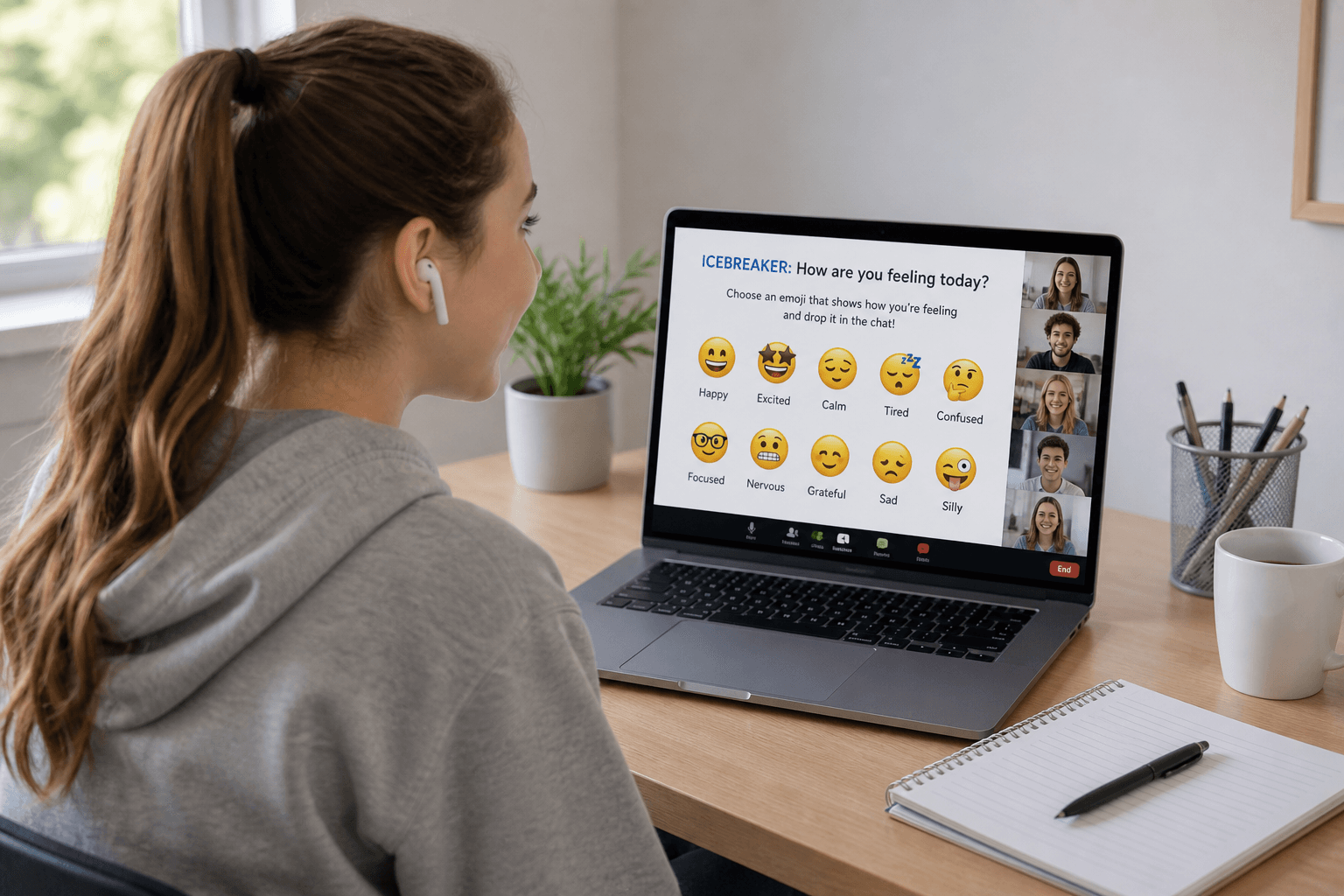
5. Online and hybrid student groups
Virtual icebreakers need to respect screen fatigue. The best ones use chat, camera, or quick visuals without becoming another long discussion.
- Emoji Introduction- Students answer with emojis first, which lowers the barrier before speaking.
- This or That Questions- Easy to run through polls, reactions, or chat with almost no setup.
- Virtual Background Story- Works well in online seminars when students can choose a background that says something about them.
6. Large student groups and assemblies
When you have 25, 50, or 200 students, simplicity beats cleverness. Use formats that scale cleanly and do not rely on long debriefs.
- Line-Up- A simple visual opener that creates movement and fast conversation in big rooms.
- Human Bingo- Excellent for orientation, house systems, clubs, and large advisory sessions.
- Scavenger Hunt- Best when students need to learn the physical space as well as meet each other.
Copy-and-use prompts for non-cheesy student icebreakers
If you want this page to save prep time, do not stop at game names. These prompt styles are safer for older students because they sound modern, specific, and optional.
Printable asset starter: student bingo prompts
If you want a simple printable resource, start with these squares for a student-safe bingo card. They are broad enough for school use and avoid the awkward adult-style prompts that often miss the mark.
For high school, swap generic squares for music, hobbies, routines, or campus-life prompts. For college orientation, add majors, dorm life, hometown distance, or study habits.
If you want ready-to-print versions instead of building your own, use our Human Bingo for Students printable page.
How we rate these student icebreakers
Instead of ranking games only by fun, this guide uses a classroom lens. These three filters are usually what determine whether an activity succeeds with students.
Social risk
One Word Check-In: 1/5 (very safe)
Two Truths and a Lie: 3/5 (depends on prompt quality)
Prep required
This or That Questions: 1/5 (almost none)
Icebreaker Bingo: 3/5 (card prep needed)
Scalability
Common Ground: 2/5 (best for smaller groups)
Human Bingo: 5/5 (excellent for large groups)
If your group is hesitant, always optimize for lower social risk first. Students will forgive a simple game much faster than an awkward one.
Teacher notes: how to make student icebreakers land better
- Explain why you are doing the activity. Students engage more when they know the purpose is to help the group work better.
- Use age-appropriate prompts. The same game can feel excellent in college and childish in high school if the prompt design is wrong.
- Offer a pass option. This protects shy students and increases trust for future participation.
- Keep the first round shorter than you think. Ending early usually leaves students with a better impression.
- For multilingual or mixed-confidence groups, give think time before asking people to speak.
Editorial approach and trust notes
This page was written for educators and facilitators serving student audiences in North American and English-speaking contexts. We prioritized activities that can be adapted for K-12 classrooms, tutoring groups, clubs, orientation programs, and online learning. The goal was not to produce the biggest list. The goal was to recommend activities that a teacher or facilitator could realistically run with limited time and mixed student confidence levels.
- Selection criteria: low prep, clear instructions, age fit, and realistic classroom use.
- Review lens: social risk for shy students, class management friction, and usefulness across different group sizes.
- Editorial method: each recommendation was screened for first-day usefulness, teen resistance to cheesy prompts, and whether the game could be adapted for online or large-group use.
- Audience assumptions: this guide is most relevant for US, Canadian, UK, and similar English-speaking school contexts.
- Update note: reviewed and updated on May 5, 2026, to reflect current search intent around school, high school, college, and online use cases.
FAQ about icebreaker games for students
What are the best icebreaker games for shy students?
Start with predictable, low-pressure formats such as One Word Check-In, This or That Questions, or Common Ground. These options give students structure and reduce the fear of saying the wrong thing in front of peers.
What icebreakers work best for high school students?
High school students usually prefer activities that feel quick, social, and not childish. Two Truths and a Lie, Line-Up, and Human Bingo are strong choices when you adapt the prompts to teen interests and keep the pace moving.
What are good online icebreaker games for students?
Online classes usually benefit from short formats that work through chat, reactions, or a quick turn on camera. Good choices include Emoji Introduction, This or That Questions, and Virtual Background Story.
Use this page as your starting hub, then open the linked game pages for full instructions. If you are building a student-friendly facilitation toolkit, also browse the full icebreaker games library.